
Master Crew List data
The same personal and passport data set, still submitted to CBP. MCL Pro makes it easier for you to keep your live records current as your roster changes without full-scale eAPIS re-uploads.
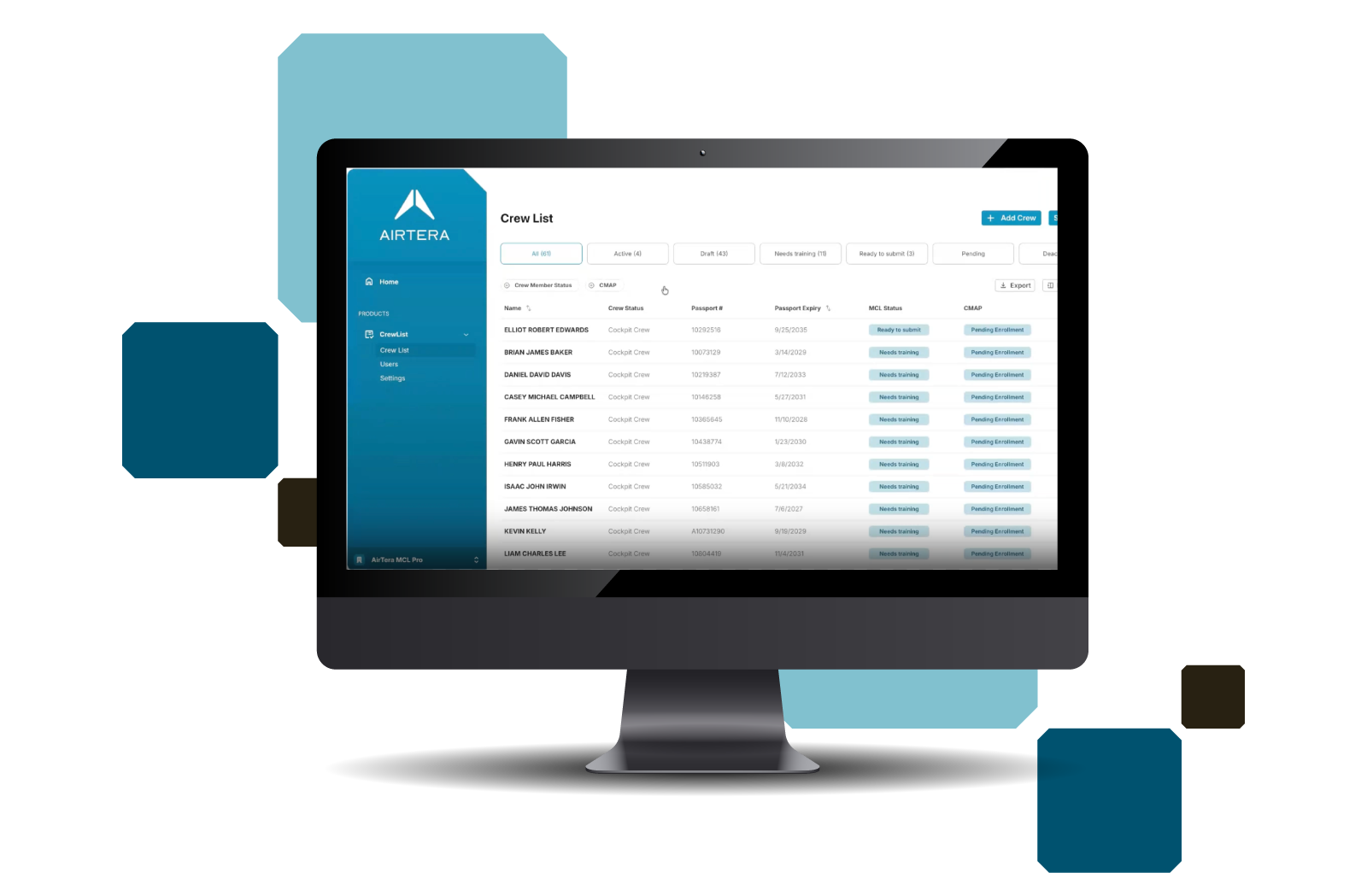
MCL Pro is our consolidated Master Crew List and CMAP management platform. The platform enables MCL submissions both to TSA (for CMAP enrollment) and CBP (for port re-entry), delivers CMAP training to and collects biometric attestations from crewmembers, and tracks eligibility for your crewmembers all a single system.
The same personal and passport data set, still submitted to CBP. MCL Pro makes it easier for you to keep your live records current as your roster changes without full-scale eAPIS re-uploads.
TSA provides the attestation. Crew members read the conditions and sign digitally inside MCL Pro, and the record stays attached to their profile; you will be ready for your next audit without having to manage reams of paperwork.
TSA requires but does not provide CMAP training. AirTera does. Our program carries forward the training we ran for KCM as the GA provider, updated for CMAP.
Joe Dalton, Chief Compliance Officer, AirTera
Aircraft operators told us the MCL management tools they had were out of date, hard to update, and easy to get wrong. MCL Pro is intuitive and user-friendly, so a new administrator can pick it up on day one.
MCL status and CMAP enrollment status by crewmember appear on every page. You always know where each crew member sits in the process, whether they need to complete training, are ready to submit to the TSA for CMAP enrollment, or they are deactivated.
Update a single pilot without re-uploading a full crew list. Enroll or unenroll someone from CMAP with one click, and deactivate crew the same way, making it easy to stay compliant with TSA’s required update timelines.
Crew codes are built into the system and selected as you add each person. If someone does not meet CMAP eligibility requirements, the enrollment option is simply not available. When someone completes required training and attestation submissions, their crew code flips automatically.
Enrolling a crew member triggers an email telling them their company has enrolled them in CMAP. They log in, complete the training, review the attestation conditions, and sign. The system chases completion so that you do not have to.
Add administrators by email and see exactly what each role can do. An ops manager role gives view access to the MCL without edit rights.
Filter to any group, such as everyone pending CMAP enrollment. Edit and reorder columns to fit how your team works. Export reports whenever you need them.
MCL Pro submits both to TSA, which manages crew codes and CMAP eligibility matter, and to CBP (for port re-entry). You stop maintaining separate CBP and TSA submission processes.
Crew who belong on your MCL but are not CMAP eligible, such as cabin attendants, can be managed in MCL Pro free of charge.
Asked and answered by our compliance, operations, and customer success teams.
Eligibility requirements for CMAP are the same as they were for KCM, including a returned CHRC for pilots. Member statuses in MCL Pro reflect those requirements; so if you select a role that is not eligible, the CMAP enrollment option is not offered, making compliance easy.
Yes. MCL Pro submits to TSA and to CBP in parallel. You no longer need whatever process you use for CBP today.
It is largely automatic. Contact Customer Success, send us one document with your crew data, and we handle the load to get your crewmembers into the system.
No. MCL Pro is a full end to end MCL tool that enables you to manage all individuals on your MCL. Crew members who belong on your MCL but are not CMAP eligible can be managed in the platform at no charge. You simply cannot enroll them in CMAP.
It is a programmatic build, developed with aircraft operators for operators in harmony with TSA guidelines. AirTera was the KCM training provider for Part 135 aircraft operators, and we updated that existing training program for CMAP.
Now. Contact Customer Success and we will begin onboarding. Current KCM customers have access at no additional cost through the end of 2026.
Explore a comprehensive suite of aviation solutions covering key FAA certifications and operations, including Parts 121, 125, 135, 139, 145, and 91/91K. This overview highlights how our solutions support operators, airports, repair stations, pilots, and training programs with clear guidance, streamlined compliance, and operational efficiency across the aviation ecosystem.
Part 135 and Part 125 FAA certificate holders use aircraft for chartered flights; the difference between the two certificates is the size of the aircraft used.
Carriers providing regularly scheduled commercial flights, like airlines and cargo transport, are required to have a Part 121 air carrier certificate.
Some airports hold a FAA Part 139 airport operating certificate. These airports serve scheduled and unscheduled flights on aircraft with more than 30 seats.
A Fixed Base Operator (FBO) is essentially a private terminal for non-commercial flights that is located on airport property.
Any aircraft repair operation that wishes to work on regulated aircraft must obtain a Part 145 Repair Station certification from the FAA.
As the name suggests, these pilots work for private clients or for aircraft operators as an independent contractor with a contractor agreement.
Aircraft that is not operated under Parts 135, 125 and 121 are generally classified as Part 91 and do not require an FAA air carrier certificate.
When choosing a flight school, students can select either a Part 61 school or a Part 141 school with FAA-approved curriculum.