Operators (Part 125 / 135)
Part 135 and Part 125 FAA certificate holders use aircraft for chartered flights; the difference between the two certificates is the size of the aircraft used.
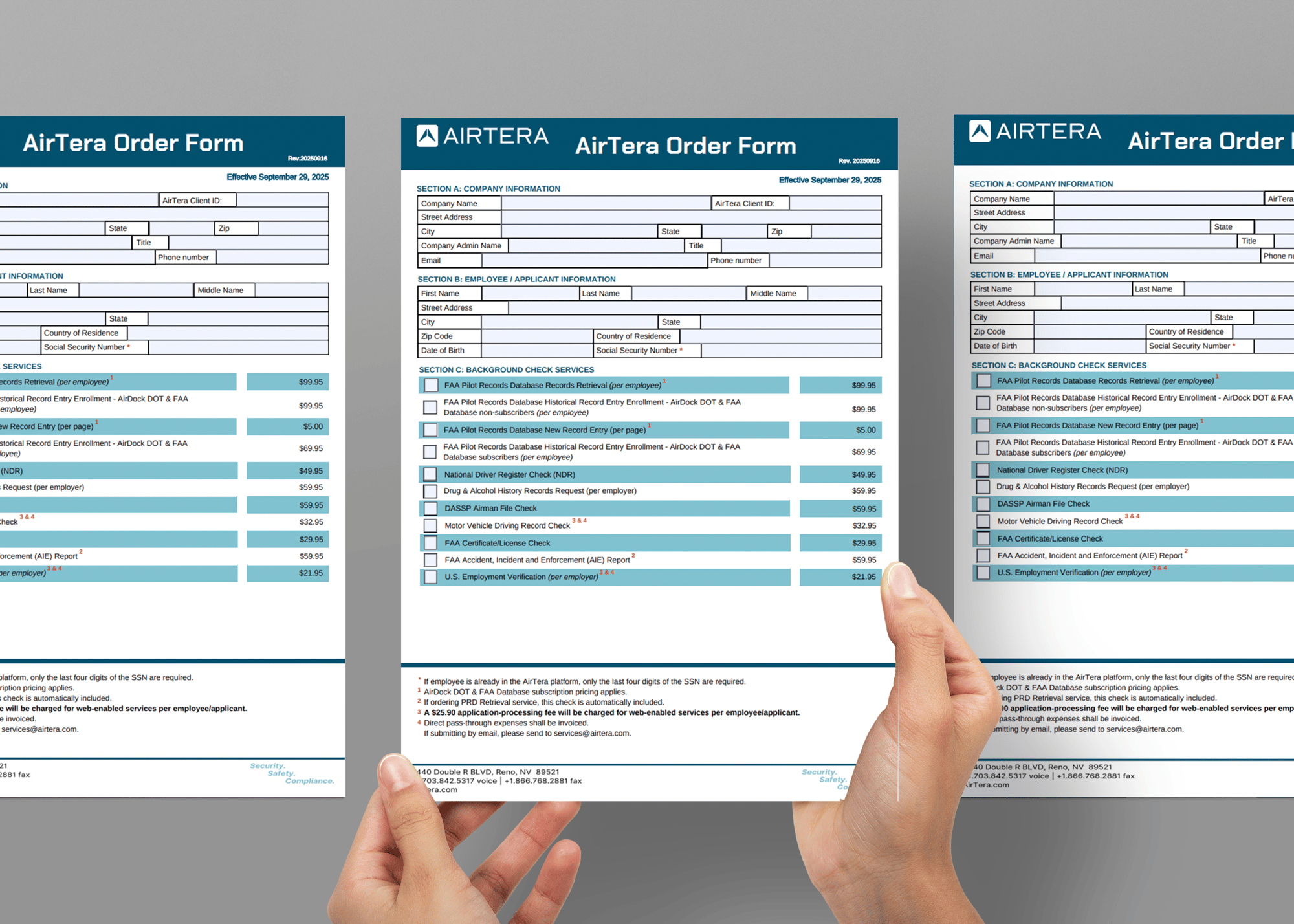
Order and track your regulated and non-regulated background checks in our platform. Our team reviews your paperwork and submits requests on your behalf. When responses come, you receive notice so you can review them.
When requesting a FAA or DOT records check, you know that one piece of missing information or error can cost you time, money and aggravation. We act as your Designated Agent, giving you the power to focus on other things.
Federal Aviation Administration
DCA Access Standard Security Program – Airman File Check
Pilot Records Improvement Act of 1996 (PRIA)
National Driver registers Check
Department of Transportation
Drug & Alcohol History Check
Security Threat Assessments (STAs)
Order, track and review these checks within our security compliance platform.
Aviation Employee Vetting (AEV)
The TSA Aviation Employee Vetting (AEV) requires all TSA regulated operators to submit certain employees for vetting.
Experience a seamless and fully-automated process within our security compliance platform.
For more information, contact us at info@airtera.com.
AirTera’s Pilot Records solution simplifies compliance for FAA-regulated operators by centralizing the retrieval, management, and entry of pilot records within a single secure platform. Designed for Part 121, 125, and 135 operators, the service supports full use of the FAA’s Pilot Records Database (PRD), allowing AirTera to act as your proxy, requesting records, uploading them for review, and ensuring timely, accurate data entry. By streamlining records retrieval, storage, and PRD updates, the platform reduces administrative burden while helping your operation stay compliant and audit-ready.

Explore a comprehensive suite of aviation solutions covering key FAA certifications and operations, including Parts 121, 125, 135, 139, 145, and 91/91K. This overview highlights how our solutions support operators, airports, repair stations, pilots, and training programs with clear guidance, streamlined compliance, and operational efficiency across the aviation ecosystem.
Part 135 and Part 125 FAA certificate holders use aircraft for chartered flights; the difference between the two certificates is the size of the aircraft used.
Carriers providing regularly scheduled commercial flights, like airlines and cargo transport, are required to have a Part 121 air carrier certificate.
Some airports hold a FAA Part 139 airport operating certificate. These airports serve scheduled and unscheduled flights on aircraft with more than 30 seats.
A Fixed Base Operator (FBO) is essentially a private terminal for non-commercial flights that is located on airport property.
Any aircraft repair operation that wishes to work on regulated aircraft must obtain a Part 145 Repair Station certification from the FAA.
As the name suggests, these pilots work for private clients or for aircraft operators as an independent contractor with a contractor agreement.
Aircraft that is not operated under Parts 135, 125 and 121 are generally classified as Part 91 and do not require an FAA air carrier certificate.
When choosing a flight school, students can select either a Part 61 school or a Part 141 school with FAA-approved curriculum.
Streamline your safety, security, and identity workflows with intelligent, AI-powered solutions built for aviation.