
Part 125/135 Operators
Part 135 and Part 125 FAA certificate holders use aircraft for chartered flights; the difference between the two certificates is the size of the aircraft used.
The AirTera team created our Learning Management System for Airports. We maintain the software with updates and new enhancements on a continual basis. Our IT team collaborates with clients to ensure systems have the latest features and performs at a near 100% uptime. The presentation upload technology Simple Course Builder was developed by AirTera to meet client needs.
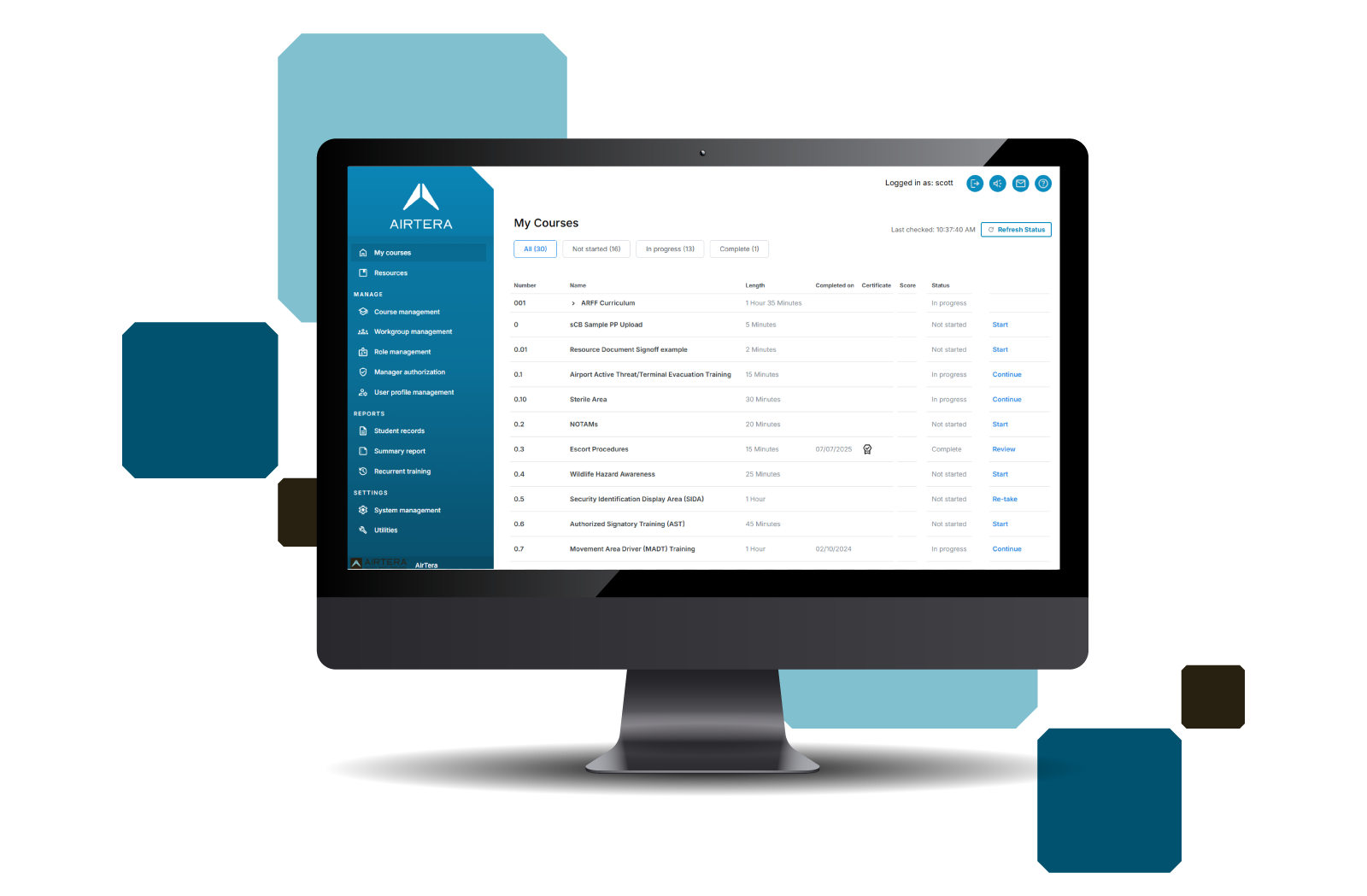
The Learning Management System provides a secure training solution with flexible pricing plans based on various budgets.
Clients can begin with one low monthly fee and implement it in one week with little effort.
Partner with our custom course development team to create engaging eLearning courses that meet your training objectives. You provide the content and we do the rest.
Our in-house team of instructional designer professionals and multimedia developers will collaborate with you to create eLearning courses customized to your specific training requirements.
We know audience-appropriate training is most impactful. Let us develop 3-D gaming aspects into your next project.
SCB allows clients to create and deploy additional training to the LMS using easily accessible static slide presentation programs like PowerPoint!
Even read and sign documents can be tracked.
Compliance recordkeeping with automated training delivery
Secure digital training records
Provide employees and tenants with FAA/TSA regulatory airport safety and security training
Maintains online training archives
Integrates with third-party airport badging. access-control and HR systems
Explore a comprehensive suite of aviation solutions covering key FAA certifications and operations, including Parts 121, 125, 135, 139, 145, and 91/91K. This overview highlights how our solutions support operators, airports, repair stations, pilots, and training programs with clear guidance, streamlined compliance, and operational efficiency across the aviation ecosystem.
Part 135 and Part 125 FAA certificate holders use aircraft for chartered flights; the difference between the two certificates is the size of the aircraft used.
Carriers providing regularly scheduled commercial flights, like airlines and cargo transport, are required to have a Part 121 air carrier certificate.
Some airports hold a FAA Part 139 airport operating certificate. These airports serve scheduled and unscheduled flights on aircraft with more than 30 seats.
A Fixed Base Operator (FBO) is essentially a private terminal for non-commercial flights that is located on airport property.
Any aircraft repair operation that wishes to work on regulated aircraft must obtain a Part 145 Repair Station certification from the FAA.
As the name suggests, these pilots work for private clients or for aircraft operators as an independent contractor with a contractor agreement.
Aircraft that is not operated under Parts 135, 125 and 121 are generally classified as Part 91 and do not require an FAA air carrier certificate.
When choosing a flight school, students can select either a Part 61 school or a Part 141 school with FAA-approved curriculum.
Streamline your safety, security, and identity workflows with intelligent, AI-powered solutions built for aviation.